What Tech Stack Should a Growing Business Build On?
React, templates, or custom? A decision framework for founders who don't want to rebuild in six months.
Nidhi Dhruv
Founder | Brand Consultant
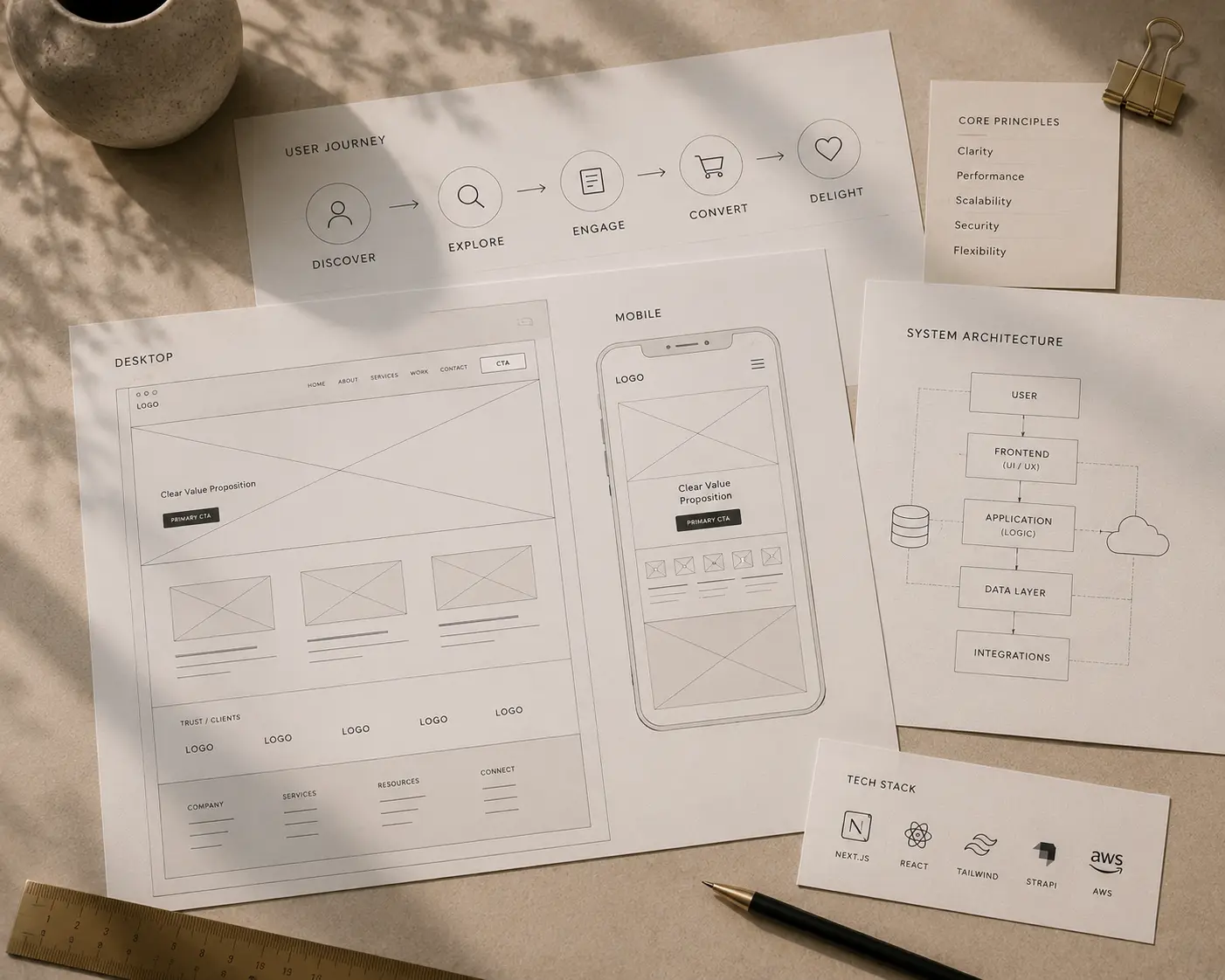
"What tech stack should we use?" is one of the most overthought questions in early-stage India — and one of the most underthought when the wrong choice creates a rebuild six months later. The answer is not React vs WordPress. It is: what does your business need the site to do in year one and year three?
Three paths founders actually take
1. Templates and page builders
Best for: validation, simple brochure sites, businesses with stable content and no custom functionality. Risk: performance bloat, limited SEO control, painful migration when you outgrow the platform. Cost: low upfront, high when you rebuild.
2. Modern front-end frameworks (React, etc.)
Best for: businesses that need component reuse, performance control, integration with apps or dashboards, and content that evolves. Risk: over-engineering a five-page site. Cost: moderate to high, but durable if architecture is intentional.
3. Custom full-stack
Best for: products with user accounts, booking engines, data dashboards, or complex workflows. Risk: building product before validating demand. Cost: highest — justified only when the site is the product.
Decision framework
- List what the site must do in 12 months — not what it might do someday.
- Count how often content will change and who will change it.
- Define performance and SEO requirements (mobile India, Core Web Vitals, indexability).
- Ask what happens when you need a new page, region, or integration.
- Match stack to those answers — not to what your developer friend prefers.
Stack choice is architecture choice
The stack is not separate from web architecture. A React site with no content model, no performance budget, and no SEO structure is just an expensive template. A WordPress site with clean architecture, caching, and semantic markup can outperform a poorly built custom app. The stack matters less than the decisions wrapped around it.
AI readiness starts with structure
If you care about being discoverable in AI search and AI assistants — and you should — your stack needs to support structured content, fast load times, and clear semantic markup. That is less about which JavaScript framework you pick and more about whether your architecture produces pages machines can parse. We cover the specifics in AI search readiness.
Mistakes we see in India
- Choosing WordPress with 40 plugins for a site that needs to load in two seconds.
- Building a React SPA with no server-side rendering and wondering why Google cannot index it.
- Hiring the cheapest developer and inheriting unmaintainable code.
- Copying a startup's stack without copying their team, budget, or product complexity.
Our bias, stated plainly
For businesses that plan to grow — hospitality, healthcare, B2B services, platforms — we build on modern front-end architecture with performance and SEO as requirements, not afterthoughts. For pure validation, we tell founders to keep it smaller. The worst outcome is the wrong stack for the wrong stage.
Avoid the traps that come from bad early choices: website mistakes first-time founders make. Understand the bigger picture in website vs web architecture.
We help founders choose and build stacks they will not outgrow in six months from our Gurgaon web studio. Book a clarity call for an honest recommendation based on your stage, not our favourite framework.
Continue Reading
Related writing from the journal.
Have a project that needs this level of thinking?
We write about what we build. If you need brand, web, or document systems with the same degree of structure and clarity, start a conversation.