Website vs. Web Architecture: What's the Actual Difference?
Why a beautiful website can still fail your business — and why architecture decisions determine whether you scale.
Nidhi Dhruv
Founder | Brand Consultant
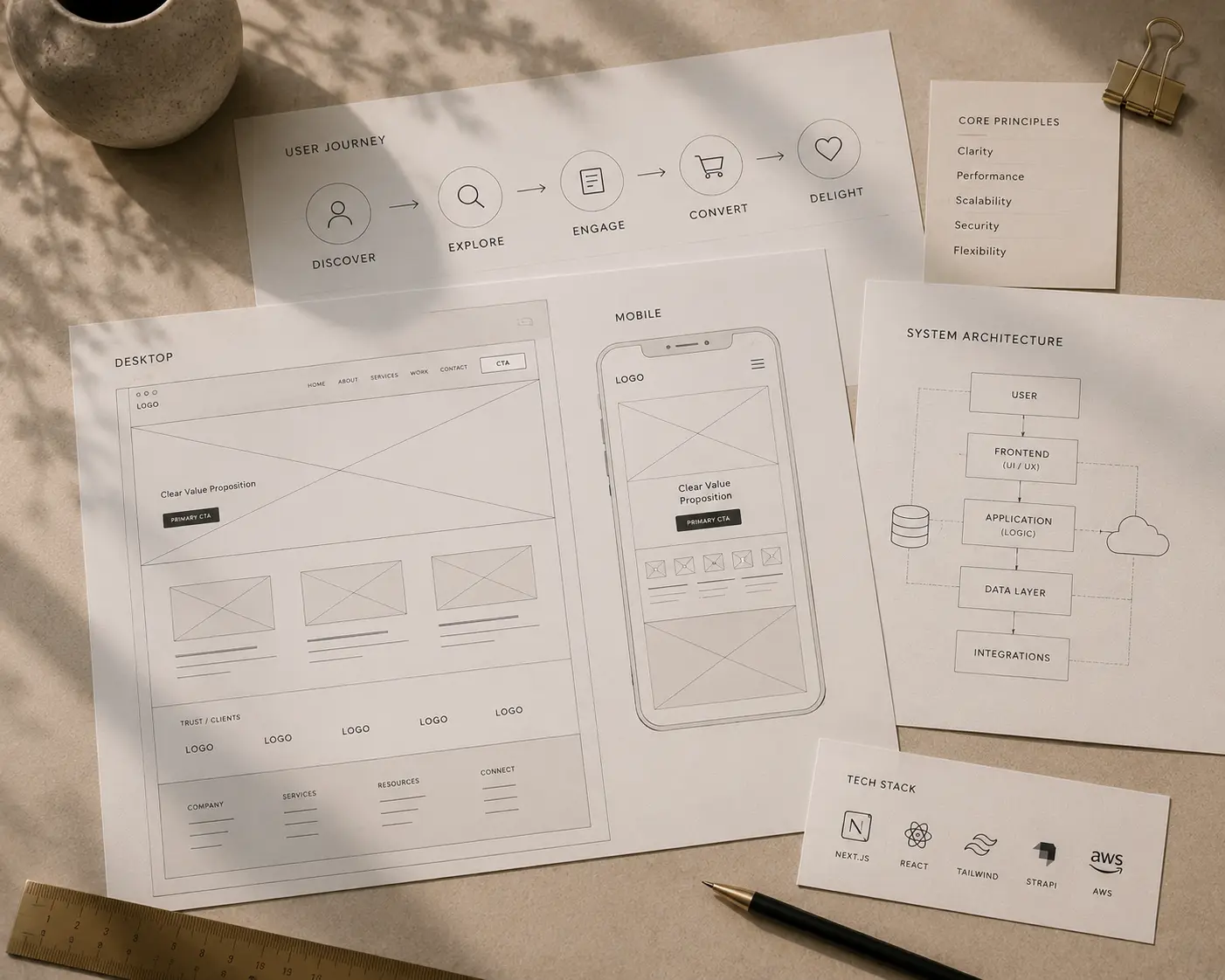
A website is what visitors see. Web architecture is what makes that experience work — today, in six months, and when your team tries to add a new service page without calling a developer. Founders often buy the first and ignore the second. That is why beautiful sites fail.
Website: the surface
A website is pages, visuals, copy, and calls to action. It is judged in a browser tab. Templates, page builders, and agency portfolios all sell at this layer. For a five-page hospitality brand or a clinic with stable offerings, a well-built surface may be enough — if the structure underneath is sound.
Web architecture: the structure
Architecture covers information hierarchy, routing, performance budgets, content models, component systems, SEO foundations, analytics hooks, and handoff documentation. It answers: Can we add a landing page without breaking layout? Will this load fast on mobile in Tier-2 cities? Can Google index it? Can a marketer update copy without a deploy?
A website is a product you launch. Web architecture is the system you operate.
Why the difference matters for growing businesses
We see this pattern constantly: a founder launches a template site, gets early traction, then needs regional pages, a blog, integration with booking, or a partner portal. The template cannot stretch. The rebuild costs more than architecture-first would have cost upfront — plus the SEO and credibility gap during migration.
CareerBytes: when architecture earns its keep
For CareerBytes, a career intelligence platform, the site needed to grow with product narrative, content, and partnership pages — not stay frozen as a static brochure. Architecture decisions (component structure, content hierarchy, performance baseline) were what made iteration possible without starting over each quarter.
How to tell what you are buying
- Website-only deliverables: designed pages, responsive layouts, basic CMS access.
- Architecture deliverables: sitemap rationale, component library, performance targets, SEO structure, analytics plan, and documentation for future changes.
- Red flag: an agency that cannot explain how you will add a page in three months without their help.
When you need which
- Validation stage: a focused website (even a landing page) is fine. Keep it small.
- Growth stage: invest in architecture — especially if brand, content, and product evolve together.
- Scale stage: architecture is non-negotiable. Stack choice, caching, and content models all matter. See tech stack for growing businesses.
Brand and architecture together
When brand identity defines how trust looks and web architecture defines how trust performs, they should be built in conversation — not in separate silos. That is how engagements like SocialGully (hospitality) and Dental Bliss (healthcare) stay coherent from waiting room to homepage.
Deciding whether to build now? Read whether you need a website on day one. Want to avoid the common traps? See website mistakes first-time founders make.
We build web architecture for businesses that plan to grow — not one-off brochure sites that need replacing. Start with our web development company in Gurgaon overview, or book a clarity call to talk through whether you need a launch site or a durable system.
Continue Reading
Related writing from the journal.

Have a project that needs this level of thinking?
We write about what we build. If you need brand, web, or document systems with the same degree of structure and clarity, start a conversation.